
IDENTIFICATION EXPLAINED
Fake ID vs. Novelty ID: What’s the Difference?
The terms “fake ID” and “novelty ID” are often used interchangeably online, but they don’t always mean the same thing. Understanding the difference starts with the card’s intended purpose, how it is represented, and whether anyone is trying to use it as official identification.
Written by Kenny Farris · Identification practices and venue security
The short answer
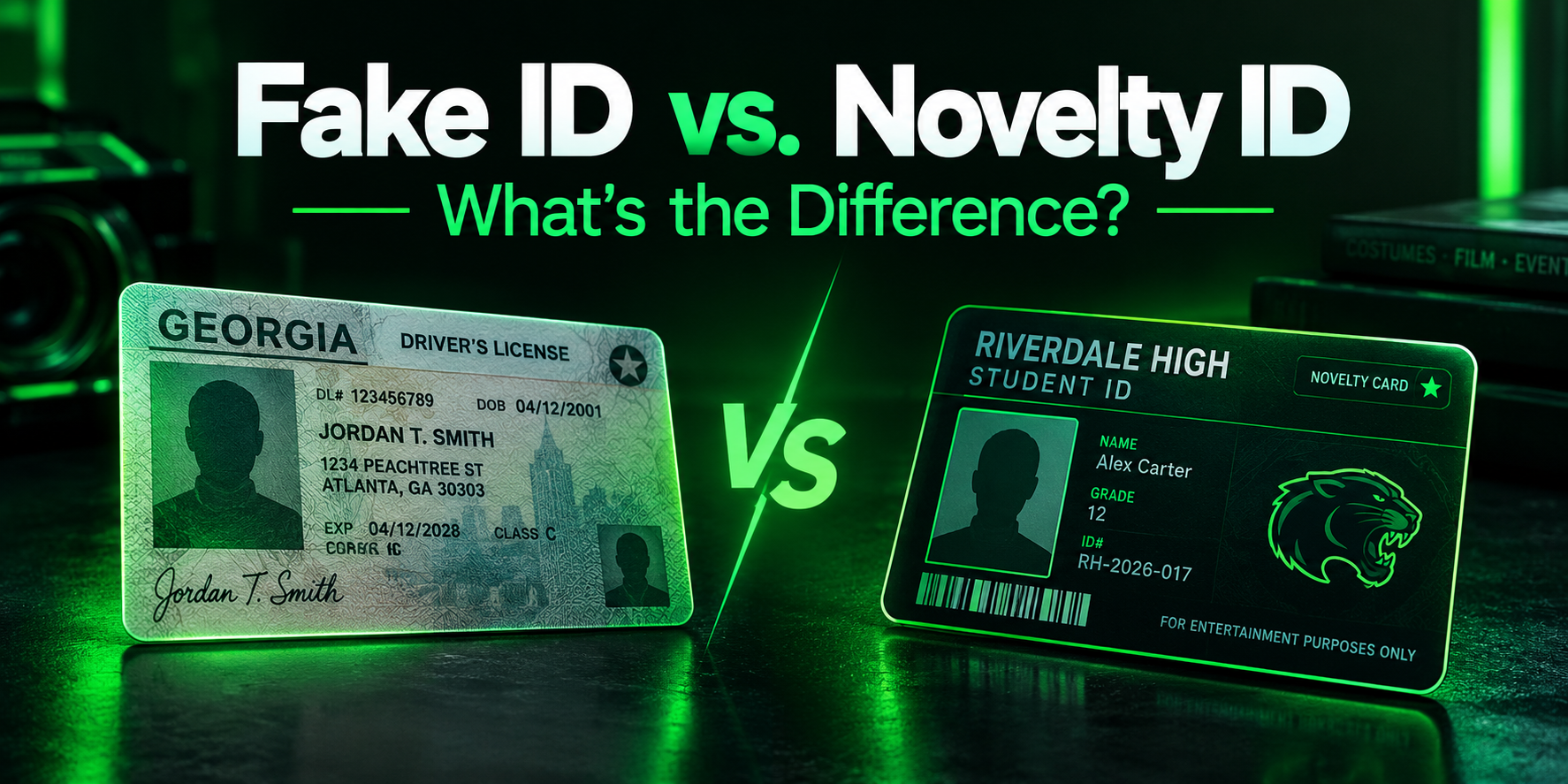
A novelty ID is generally designed as a prop, souvenir, costume accessory, or fictional identification item. A fake ID, depending on the context, can mean an imitation intended to mislead someone into accepting it as genuine government-issued identification. The important distinction is not simply what a card looks like; it is what it represents and how it is used.
1. What Does “Fake ID” Mean?
“Fake ID” is a broad, informal phrase. People use it to describe different things, from a fictional card made for a film to an imitation document intended to be accepted as an official credential. That ambiguity is one reason the term can cause confusion in online searches.
In everyday conversation, people may use the phrase without explaining what kind of card they mean. But in a security, legal, or business context, the intended use matters. A prop created for a fictional character is not the same as a document presented to a venue, employer, government agency, or other organization as proof of identity or age.
From my perspective working in security in Georgia and downtown environments, identification needs to be understood in context. A card’s appearance alone doesn’t establish that it is official, valid, or suitable for a particular purpose.
If you’re starting with the terminology, my guide to what a novelty ID card actually is explains the basic concept in more detail.
2. Fake ID vs. Novelty ID: Key Differences
The terminology isn’t always used consistently by sellers or customers. The table below explains the general distinction, rather than making a legal determination about every card or situation.
| Consideration | Novelty ID or prop | Fraudulent imitation |
|---|---|---|
| Purpose | Created for a clearly identified prop, novelty, costume, or souvenir purpose. | May be intended to misrepresent identity, age, or official status. |
| Representation | Should be clearly presented as non-official when that distinction matters. | May be presented deceptively as genuine identification. |
| Appropriate setting | Potentially suitable for film, theater, photography, or collecting, depending on its design and use. | Not appropriate for deceiving an organization or substituting for official credentials. |
| Official status | Does not become government-issued identification simply because it resembles a card. | An imitation does not gain official status through appearance alone. |
There can be gray areas in how a particular item is designed, marketed, or used. A label such as “novelty” is not a blanket exemption from applicable law. The surrounding facts and the rules of the relevant jurisdiction still matter.
3. What Are Novelty IDs Used For?
Novelty identification cards and fictional credentials can have legitimate uses when their non-official nature is clear and they are used appropriately. The important thing is that a prop should support the project it was made for, not be mistaken for a real credential.
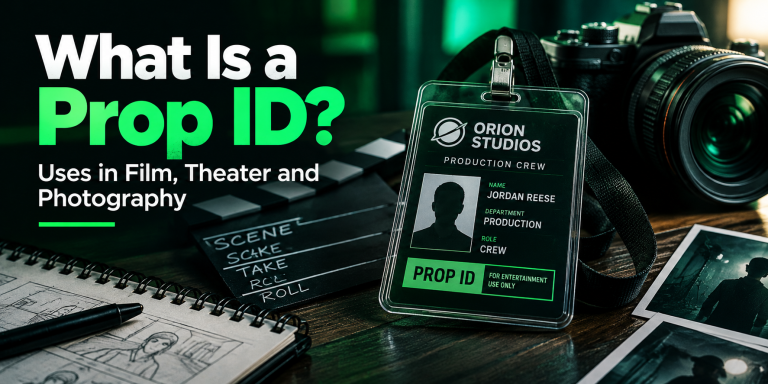
Film and theater
Fictional characters may need an invented credential as part of a scene, costume, or production.
Photography
A clearly fictional card can be used as a visual accessory in staged photography or creative projects.
Costumes and events
An invented badge or character card can help complete a costume or themed event experience.
Collecting and display
Some people collect novelty cards, fictional credentials, or memorabilia as personal keepsakes.
For more examples, see our practical guide to novelty ID card uses. The right design depends on the project, but it should remain clear that the card is a prop rather than a substitute for official identification.
4. Design Tools and Legal Considerations
People creating fictional cards for creative projects may use general graphic-design tools to plan layouts, colors, typography, and other visual elements. For example, Canva is an online design platform that readers can explore for general graphic-design projects.
A design platform is not an official identification issuer, and creating a design does not make it a valid government document. Keep fictional props distinct from official credentials, and don’t represent a privately designed card as government-issued identification.
The legal position depends on the card, its intended use, and the jurisdiction. Laws may distinguish between possessing a prop, making or altering a document, misrepresenting identity, and presenting false identification to obtain a benefit or access a restricted activity.
A novelty label doesn’t automatically make every design or use lawful. Likewise, a fictional card created for a production should not be assumed to have the same legal implications as a document deliberately presented as genuine. The specific circumstances matter.
For broader regional context, read our overview of novelty ID laws in the US, UK, and Canada. For a specific legal question, consult current official guidance for the relevant jurisdiction.
A practical reminder
If you need to prove your identity or age, use identification accepted by the organization or authority involved. A novelty card or entertainment prop is not a replacement for an official document.
5. What Should You Look for on a Novelty ID Website?
If you’re researching a novelty or prop-card provider for a legitimate project, start with how clearly the business explains its products. A responsible provider should make it easy to understand what is being sold and what the item is intended for.
- Clear product descriptions: The site should explain whether its cards are fictional props, souvenirs, or novelty products.
- Honest representation: Product pages should not imply that a privately made novelty card is government-issued or officially valid.
- Transparent policies: Look for accessible information about payment, shipping, returns, and customer support.
- Suitable customization: Design options should be explained in the context of legitimate fictional, creative, or souvenir use.
- Consistent information: The product description, checkout terms, and business policies should tell the same story.
- Reasonable claims: Be cautious of any seller promising official status or guaranteed acceptance for a privately produced novelty card.
These criteria are useful for assessing a business’s transparency, but they are not proof that a seller is trustworthy or that a product is lawful in every situation. Check the actual terms and product information before making a decision.
Our article on novelty and prop ID websites discusses the terminology people encounter online and why it’s worth reading product descriptions carefully.
6. Why the Distinction Matters in Venue Security
In venue security, identification checks are connected to a specific decision: whether a person has provided documentation the venue can accept for its age-verification or entry policy. A novelty card isn’t made suitable for that purpose by its design, its material, or the name a seller gives it.
My work in security in Georgia and downtown environments has taught me that clear policies and consistent procedures matter. Staff need to understand which documents their venue accepts and how to handle situations that fall outside those rules. A prop has a different purpose from an official credential, and treating the two as interchangeable creates unnecessary confusion.
For customers, the simplest approach is to bring the required official identification and check the venue’s entry requirements in advance. For people buying props, the responsibility is to keep the intended use clear and avoid presenting a fictional item as an official credential.
Frequently Asked Questions
Is a novelty ID the same as a fake ID?
Not necessarily. A novelty ID is generally intended as a prop, souvenir, or fictional item. “Fake ID” is a broader informal term that can also refer to an imitation intended to deceive someone into accepting it as genuine identification.
Can a novelty ID be used as proof of age?
A novelty card should not be treated as a substitute for official proof of age. Use a document accepted by the relevant venue, business, or authority.
Are novelty IDs legal in every state?
Don’t assume the same rules apply everywhere. The design, intended use, conduct involved, and applicable state or national law can all matter. Check current official guidance for the relevant jurisdiction.
Can novelty IDs be used in films and theater?
Fictional identification props can be used in creative productions, subject to applicable laws and production requirements. Keeping the item’s fictional purpose clear helps avoid confusion outside the intended setting.
Does calling a card a novelty item automatically make it legal?
No. A product label alone doesn’t determine legality. The card’s characteristics, how it is represented, the conduct involved, and the relevant law may all be important.
Kenny Farris · Final thoughts
Know What the Card Represents
The difference between a novelty ID and a fraudulent imitation comes down to more than terminology. Purpose, representation, and use all matter. A fictional prop can have a legitimate place in a production, costume, collection, or creative project, but it should never be confused with official identification.
If you remember one thing from this guide, make it this: use official identification when official identification is required, and keep novelty props within their intended role.