What Is a Prop ID? Uses in Film, Theater and Photography
A prop ID is a fictional identification card created for use in entertainment, creative projects, staged environments or visual storytelling. The term is commonly used for cards designed to help a character, scene or production look more convincing without representing a genuine government-issued identification document.
Prop IDs can appear in films, television productions, theater performances, promotional photography, student projects and costume displays. Depending on the project, a card might represent a fictional company employee, a made-up character, a production crew member or an imaginary organization.
The important distinction is that a prop ID is an entertainment object, not a substitute for official identification. Its purpose is to support a creative scene or visual concept, rather than to establish a person’s real-world identity, age or legal status.
This guide explains how prop IDs are used, what makes a design suitable for a production, how they differ from official documents and what to consider when choosing a prop for a creative project.
What Does “Prop ID” Mean?
In film and theater, a prop is an object used by performers or placed within a scene to help communicate a story. Props range from ordinary objects, such as notebooks and coffee cups, to specialized items made specifically for a production.
A prop ID follows the same principle. It is a designed object that gives the audience visual information about a character or fictional setting. For example, a scene set inside an imaginary technology company might include employee badges bearing the fictional company’s name and logo.
The card does not need to function as a real credential. It only needs to serve its intended purpose within the production. In some cases, the audience sees the card briefly. In others, it may be shown close to the camera or included in promotional photographs, making the design more noticeable.
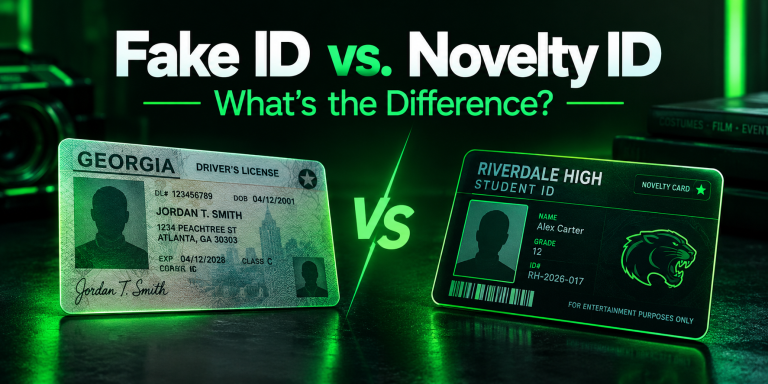
Prop IDs are also different from ordinary novelty cards in their intended use. A novelty card may be collected, displayed or given as a humorous gift, while a prop ID is often designed around a particular character, scene, production or creative brief. The categories can overlap, but the intended context helps determine the most appropriate design.
For a broader introduction to the category, see our guide to what a novelty ID card is.
How Prop IDs Are Used in Film and Television
Film and television productions often use carefully selected visual details to make fictional worlds feel consistent. An identification card can help communicate where a character works, which organization they belong to or what role they play in a scene.
1. Fictional employee badges
A scene set in an imaginary business may include staff badges with fictional names, departments and company branding. These details can help establish the setting without requiring the production to use a real company’s credentials.
For example, a fictional organization called Orion Studios might issue a production badge to a character named Alex Morgan. A made-up logo, clearly fictional organization name and entertainment-only wording help distinguish the object from a real-world credential.
2. Character and story continuity
When an ID card appears in multiple scenes, the production team may need several matching copies. Keeping the character’s name, design, colors and fictional organization consistent can prevent continuity problems during filming.
Props departments may document where an item appears, who handles it and whether it needs to be replaced between takes. A simple card can become an important continuity detail if the story draws attention to it.
3. Close-up shots
A card shown in a close-up needs different attention from one that appears briefly in the background. Text hierarchy, contrast, spacing and legibility may become more noticeable when the camera focuses on the object.
Designers should still avoid copying the distinctive layout, seals or security features of genuine government documents. A convincing fictional design can be created through original branding, invented organizations and a consistent visual style.
Prop IDs in Theater and Live Performances
Theater productions use props to communicate information quickly to an audience. A character may display a fictional workplace badge, carry a made-up membership card or present an imaginary organization credential as part of a scene.
Unlike film, theater often requires objects to remain readable and recognizable from a distance. The best design depends on the venue, lighting conditions, audience position and how the prop is handled during the performance.
Practical considerations matter, too. A prop that is passed between performers should be durable enough for repeated handling. If it is attached to a costume, its size and weight should not interfere with movement or comfort.
For touring productions or school theater, clearly fictional names and branding can also make the prop reusable. The same basic design may be adapted for different characters or productions without resembling a real person’s credentials.
Using Prop IDs in Photography and Creative Content
Photographers, content creators and designers may use fictional ID cards to build a visual story. A staged office portrait, a character study or a promotional image may need a badge that supports the concept being presented.
For editorial photography, a prop ID can establish a fictional occupation or organization. In costume photography, it can help complete a character’s appearance. For a portfolio project, it can demonstrate how a designer approaches typography, layout and brand identity.
Creators should consider how the finished image might be interpreted outside its original context. A prop that is obviously fictional in a behind-the-scenes photograph may look more ambiguous when cropped tightly or shared without a caption. Clear fictional branding and entertainment-only labels can help preserve the intended meaning.
When publishing the image online, captions can also explain that the card was created for a fictional character or production. This is especially useful when the visual is realistic in style but not intended to represent an actual credential.
What Makes a Good Prop ID Design?
A useful prop ID begins with the needs of the creative project. Before selecting a design, consider where it will appear, how close the audience or camera will be, how often it will be handled and what information the fictional story requires.
Clear fictional identity
Use an invented organization, original logo and fictional role. Avoid real government seals, official document layouts and elements intended to make the card pass as a genuine credential. A made-up brand gives the design its own identity while keeping the purpose clear.
Readable layout
Names, roles and fictional organization details should have a clear visual hierarchy. Use legible type, sufficient contrast and sensible spacing. If the card will be seen on camera, test it at the intended viewing size rather than judging it only on a large computer screen.
Appropriate materials
The material should suit the production. A temporary paper card may work for a brief classroom exercise, while a production that uses the same prop repeatedly may need a sturdier printed card or a protective sleeve. Choose materials based on practical use rather than an attempt to imitate official security documents.
Consistency with the production
Colors, typography and fictional branding should fit the project’s setting. A futuristic science-fiction company might use a very different visual language from a fictional neighborhood theater or a made-up hospitality business.
Clear prop identification
Where appropriate, include wording such as “PROP,” “FICTIONAL” or “FOR ENTERTAINMENT USE ONLY.” This is particularly useful if the item might be seen outside the original scene or separated from its accompanying explanation.
Prop ID vs. Official Identification
Although both may be card-shaped, a fictional prop and an official identification document have fundamentally different purposes. One supports a creative project; the other is issued or recognized by an authorized organization for identity-related purposes.
| Feature | Fictional Prop ID | Official Identification |
|---|---|---|
| Primary purpose | Entertainment, storytelling or creative display | Identity or other purposes established by the issuing authority |
| Issuer | A fictional organization or creative production | An authorized government agency or recognized issuer |
| Information | Fictional names, roles and invented branding | Information governed by the relevant issuing authority |
| Visual design | Original creative design that is clearly fictional | Design and features determined by the issuer |
| Real-world use | Not a substitute for official identification | Used only for purposes accepted by the relevant authority or organization |
The key difference is not simply the card’s appearance. It is its purpose, origin and status. A professionally printed fictional card does not become official identification because it uses high-quality materials or a polished layout.
For additional context, read our article on novelty ID laws in the United States, United Kingdom and Canada. Laws and rules can differ by jurisdiction, so anyone planning to use a novelty or prop card should check the requirements that apply to their situation.
How to Choose a Prop ID Design Approach
The right approach depends on the project’s budget, schedule and creative requirements. Not every production needs a custom-designed physical card, and not every concept needs a specialized provider.
- For a simple school project: A basic layout made with a general design tool may be enough. Use fictional details and keep the result clearly identified as a prop.
- For a film or theater production: Consider continuity, durability, camera distance and how the prop will be handled by performers.
- For a photography concept: Focus on how the card appears in the frame, whether the fictional details are legible and whether the final image could be misunderstood without context.
- For a larger creative project: Document the fictional brand, approved design and intended use so that replacement props remain consistent.
General design platforms can be useful for original layouts, while a specialized prop provider may be more suitable for a project with specific production requirements. Compare options based on design flexibility, material information, revision policies, delivery expectations and clear descriptions of intended use.
For background on creative card projects, our guide to common uses for novelty ID cards provides additional examples and considerations.
Responsible Use and Practical Considerations
A prop ID should remain within the creative context for which it was made. Do not present a fictional card as a real driver’s license, government-issued identification, proof of age or authorization to enter a restricted area.
Productions should also consider where props are stored and who can access them. If a card contains a fictional name or organization, make sure it cannot reasonably be confused with an actual person’s credentials. Remove or replace designs that could create confusion when a project ends.
When a scene involves identity verification, remember that the process can involve more than looking at a card’s appearance. Organizations may use their own procedures and verification technology. For a general overview of digital identity verification, see Jumio’s identity verification overview.
That resource provides background on identity verification systems; it should not be taken as an endorsement of any particular prop design or provider. The goal of a fictional card is to support the story, not to bypass a verification process.
Frequently Asked Questions
What is a prop ID used for?
A prop ID is used as a fictional object in films, television, theater, photography, costume projects and other creative work. It can represent a character’s workplace, fictional organization or role within a story.
Is a prop ID the same as a novelty ID?
Not necessarily. The terms can overlap, but a prop ID is generally designed for a particular scene, character or production. A novelty ID may be created for collecting, display, humor or other non-official purposes. Neither should be represented as official identification unless it genuinely has that status under the applicable rules.
Can I make a prop ID for a student film?
Yes. A student film can use an original fictional card as a set or costume prop. Use invented names and branding, make its fictional nature clear and avoid copying real government documents or official credentials.
Should a prop ID say that it is fictional?
That is a sensible precaution, especially if the card may be photographed, shared online or taken outside the production environment. Wording such as “PROP” or “FOR ENTERTAINMENT USE ONLY” can help communicate its intended purpose.
Do prop IDs need to look realistic?
They need to suit the creative brief. A card may look polished and consistent with a fictional brand without copying the appearance or security features of an official document. The appropriate level of visual detail depends on the scene and how the prop will be viewed.
Can a prop ID be used as proof of identity or age?
No. A fictional prop ID is not a substitute for valid identification or proof of age. Follow the requirements of the organization or jurisdiction involved whenever official identification is required.
Final Thoughts
Prop IDs are small but useful storytelling tools. They can establish a fictional workplace, support a character’s identity within a story and add detail to a film, stage performance or photography project.
The strongest designs begin with a clear creative purpose. Original branding, readable text, suitable materials and consistent fictional details can make a prop effective without blurring the line between entertainment and official identification.
Whether you are preparing a student film, designing a costume or planning a professional production, keep the card appropriate to its setting and clearly fictional. That approach helps the prop serve the story while reducing the chance of confusion outside it.