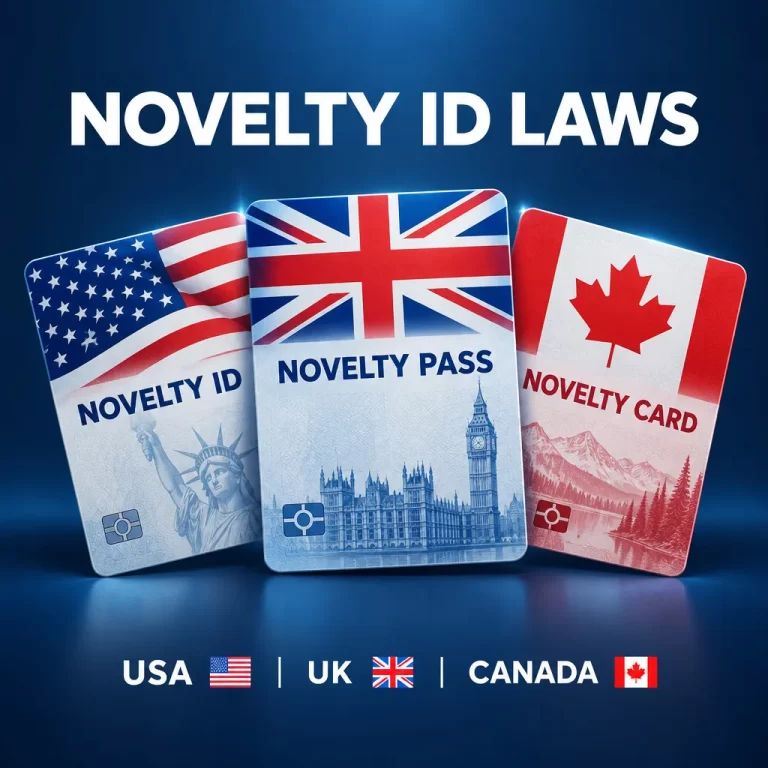

If you’ve ever searched for a “fake ID website,” you’ve probably noticed that the results can be confusing.
Some sites sell novelty cards, costume pieces and identification props. Others use similar language while advertising documents that are supposed to be accepted as genuine identification.
From my experience working in venue security, that distinction isn’t just a matter of wording. What a card looks like and what it actually is are two different questions.
This guide is for people researching novelty and prop identification products. I’ll explain what separates a legitimate prop or novelty product from official identification, what I would look for when evaluating a website, and why the wording used by a seller matters.
Important: A novelty or prop ID is not government-issued identification and should not be presented or used as genuine identification.
What does “fake ID website” actually mean?
The search term is broader than the products people may actually be looking for.
Someone might search for a fake ID website because they want a fictional identification card for a film. Another person might be looking for a costume accessory. A theater production might need several cards for fictional characters.
At the same time, the phrase can refer to websites offering fraudulent documents.
Those aren’t the same category.
For a novelty or prop business, I think the distinction should be made plainly rather than buried in a disclaimer somewhere at the bottom of a product page.
A customer should be able to understand what they’re buying before they place an order.
Novelty ID, prop ID and official ID are different things
A novelty ID is a privately produced item made for entertainment, collecting, costumes or another non-governmental purpose.
A prop ID is generally created for a creative production or event. A fictional character in a film, for example, may need an identification card as part of the story.
An official ID, by contrast, is issued by the relevant government authority and has a defined legal purpose.
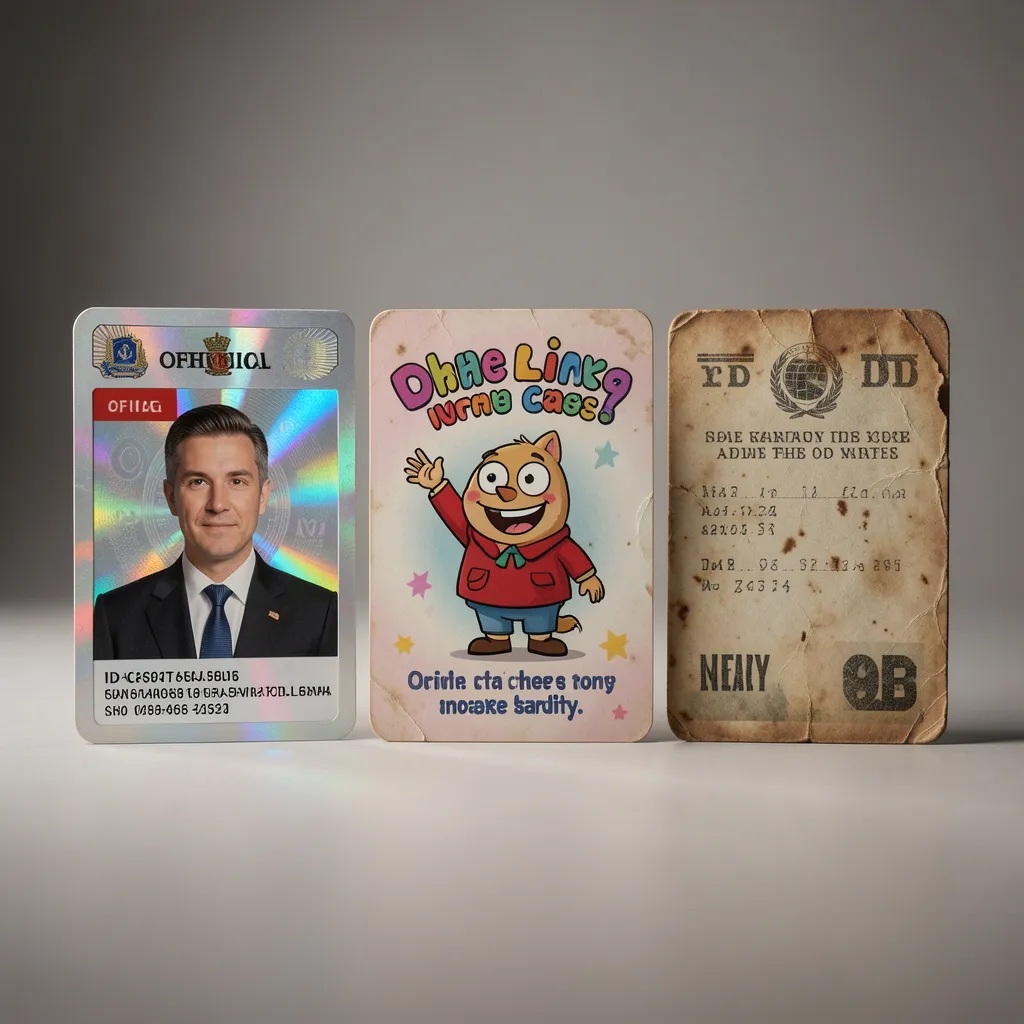
In the United States, for example, REAL ID-compliant driver’s licenses and identification cards are issued through state processes. USAGov explains that each state determines its own application process and documentation requirements.
A privately produced card does not become an official credential because it uses a familiar layout, photograph or design.
That’s probably the simplest way to understand the difference.
Why this distinction matters
I’ve spent enough time around identification checks to know that people can become focused on whether a card looks right.
That’s not the whole story.
A photograph of an ID on a website tells you very little about its legal status. A card can resemble an identification document without being issued by the authority that gives that document its legal meaning.
For a legitimate prop, that’s perfectly fine. A film prop is supposed to support a scene. A costume prop is supposed to complete an outfit. A fictional card for a theater production helps establish a character.
Problems arise when a novelty product is represented as something it isn’t.
What should you look for on a novelty ID website?
When I look at a website in this category, I wouldn’t start with the product photograph.
I’d start with the information around it.
1. Is the purpose of the product clear?
A good product description should tell you what you’re buying.
Is it a costume prop?
A film prop?
A novelty collectible?
A personalized card for an event?
The more specific the explanation, the easier it is for a customer to decide whether the product is appropriate.
2. Does the seller clearly explain that it isn’t government identification?
This is one of the most important things to look for.
If a privately produced card is a novelty item, the website should say so clearly.
The Federal Trade Commission has previously taken action against sellers of fake documents whose “novelty” and “entertainment” descriptions did not adequately address the fraudulent nature of the documents. The FTC’s 2018 announcement is a useful example of why simply attaching the word “novelty” to a product isn’t enough.
The lesson isn’t complicated: customers shouldn’t have to guess what a product actually is.
3. Can you identify the business?
Before buying anything online, I like to know who I’m dealing with.
Look for:
- A business name
- A way to contact the company
- Customer-service information
- Terms and conditions
- Privacy information
- Shipping information
- A clear explanation of the products
These details don’t guarantee that a company is good or bad. They simply make it easier to understand who is selling the product and what their policies are.
4. Does the website explain its intended uses?
A novelty ID business should be able to explain why someone might want its products.
For example, a prop ID may be useful for:
- Film and television
- Theater
- Costume events
- Photography
- Themed parties
- Entertainment
- Collecting
- Creative projects
That’s much more useful than simply displaying a photograph of a card and leaving the customer to figure out its purpose.
Don’t confuse realism with authenticity
This is something I’ve seen people misunderstand.
A prop can be designed to look convincing on camera without being an authentic government document.
Those are separate concepts.
Filmmakers frequently need objects that look appropriate within a scene. If a fictional character is supposed to have an identification card, a completely generic card might look out of place.
That’s why prop companies may offer customization.
The fact that something has been carefully designed for a production doesn’t give it government-issued status.
What about custom ID props?
Custom props are probably the easiest category to understand.
Suppose a production has a fictional character named Sarah Miller who lives in a fictional city. The production might need a card that fits the character, setting and story.
A prop designer can create an identification-style card specifically for that fictional purpose.
The same basic idea applies to theater, photography, costumes and themed events.
The product is part of the creative project.
It isn’t being issued by a government licensing authority.
What about “fake ID online” searches?
People often use broad terms when searching.
“Fake ID online” is one of those phrases where the search term itself doesn’t tell you what the person ultimately needs.
If you’re looking for a legitimate novelty or prop product, use more specific terms such as novelty ID, ID prop, custom ID prop, or film ID prop when researching your options.
Those terms make the intended use much clearer.
And if what you actually need is official identification, the appropriate source is the government agency that issues it.
For U.S. state identification, USAGov provides information about REAL ID and directs people to their state’s licensing agency for the relevant application requirements.
Why I wouldn’t choose a website based only on search rankings
A website appearing near the top of a search result doesn’t tell you everything about the company behind it.
When researching any online seller, I would look at the actual website rather than assuming that a high search position is an endorsement.
For novelty products in particular, I’d want to know:
What is the product?
What is it intended for?
Who is selling it?
What does the seller say about its limitations?
Those questions are more useful than simply asking which site appears first.
What does a responsible novelty ID business look like?
In my view, the most important thing is clarity.
The business should be comfortable explaining that its products are novelty or prop items. The products should be compatible with novelty ID laws around the globe.
The product description shouldn’t rely on ambiguity.
The customer shouldn’t have to interpret vague language to determine whether a card is official identification.
And the business should provide enough information for someone to decide whether the product fits their intended project.
That may sound basic, but clear communication matters considerably when a product resembles something that has an official purpose.
A note about the phrase “best fake ID websites”
You’ll find plenty of searches asking for the “best fake ID websites.”
I don’t think a simple ranked list is particularly helpful.
If someone needs an identification prop for a movie, the right questions are different from those of someone looking for a costume accessory.
Instead of asking which website is “best,” start with what you actually need the product to do.
For a film production, you may care about customization and whether the design works on camera.
For a costume, appearance and personalization may matter more.
For collecting, the design and production quality may be the main consideration.
And if you need official identification, a novelty website isn’t the appropriate source in the first place.
The difference comes down to the issuer and the purpose
This is the point I keep coming back to.
An official identification document gets its authority from the organization that issues it.
A novelty or prop card gets its purpose from the person or company producing it and the context in which it is used.
The two can look similar without having the same status.
That’s why I think buyers should pay attention to the description of the product rather than judging it entirely by a photograph.
Final thoughts from a security perspective
Working in security changed the way I look at identification.
When you’re checking IDs at a venue, you’re not simply looking at whether a card resembles something you’ve seen before. You’re dealing with a document that someone is presenting for a particular purpose.
That’s why I think the clearest approach for novelty products is also the most sensible one:
Call a prop a prop.
Call a novelty card a novelty card.
Don’t create unnecessary confusion about whether a privately produced item is official identification.
There are plenty of legitimate reasons to make an identification-style card. Film productions need props. Theater productions need character materials. People put together costumes. Photographers and creative projects sometimes need fictional documents.
Those uses don’t require pretending that a novelty product is a government credential.
If you’re researching a novelty ID website, look for a seller that tells you clearly what you’re buying, why the product is intended to be used, and what it isn’t.
That information is more valuable than a flashy product photograph or a promise that a website is “the best.”